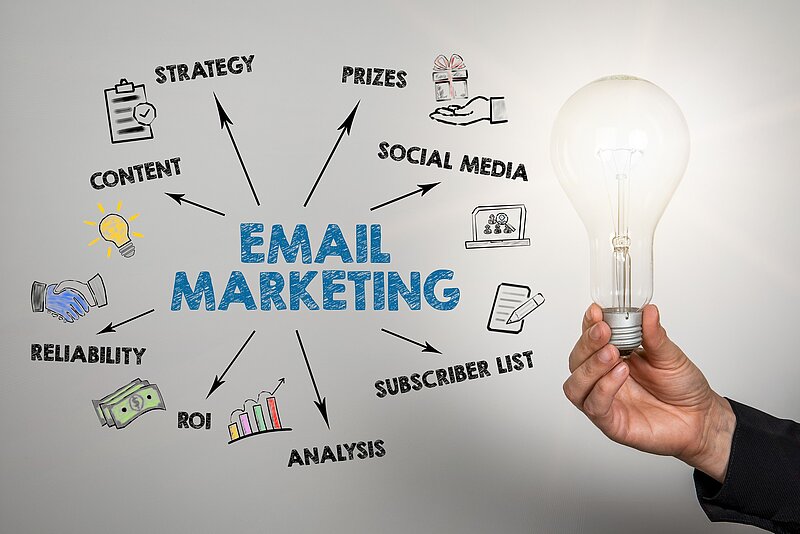
Email marketing is one of the digital channels with the best return on investment, but only when there is a strategy behind it. Sending newsletters “when there is something to say” is not enough: you need clear goals, quality lists, relevant content, automation and careful deliverability management.
This guide sets out everything you need to build an effective email marketing strategy today: from goals to the technical rules of the major mailbox providers, through to the metrics to track.
Why email marketing still works
The “death of email” has been announced for years, and for years the data has said otherwise. Email remains many users’ preferred channel for hearing from companies and one of marketers’ favourite channels for ROI. The reasons are simple:
- you own the list: you do not depend on a social network’s algorithm;
- it costs little per contact, even at high volumes;
- it is measurable at every step, from click to sale;
- it can be automated: once set up, many flows run on their own.
Types of email you should know
- Newsletters: regular content to keep the relationship alive and the brand front of mind.
- Promotional emails: targeted commercial messages, often tied to an offer.
- Transactional emails: order confirmations, shipping updates, password resets. They have the highest open rates and are a great opportunity to strengthen the relationship.
- Automated emails: messages triggered by user behaviour, such as welcome, abandoned cart or re-engagement.
How to build an email marketing strategy in 8 steps
- Set your goals: sales, loyalty, nurturing leads towards a sales conversation, brand awareness. Each goal needs different content and metrics.
- Build your list the right way: website forms, landing pages, co-registration, prize promotions, events. Always with clear, documented consent.
- Segment: customers and prospects, B2B and B2C, interests, location, purchase and engagement history. A segmented list allows more relevant messages and better results.
- Plan a calendar: email types, frequency and topics. Consistency builds recognition and trust.
- Set up the essential automations: welcome sequence, abandoned cart for e-commerce, follow-up after a contact request, re-engagement of inactive contacts.
- Get subject line, content and call to action right: a clear subject, one main message per email, an obvious call to action. More than half of emails are opened on smartphones, so design for mobile first.
- Test: compare subject lines, content and send times with A/B tests on a sample before the full send.
- Analyse and improve: every send is a chance to learn what your audience really cares about.
Deliverability: rules you cannot ignore
The best email in the world is useless if it lands in spam. Since 2024 Gmail and Yahoo have applied strict requirements to bulk senders, and Microsoft has introduced similar rules for Outlook. In short:
- domain authentication with SPF, DKIM and DMARC;
- one-click unsubscribe, clear and immediate;
- a very low spam complaint rate: too many complaints penalise all your future sends;
- clean lists: regularly remove invalid addresses and contacts that have been inactive for too long.
Privacy and consent
Promotional emails require the recipient’s prior consent under the GDPR and, in Italy, the Privacy Code. There is an exception for existing customers (the so-called “soft opt-in”): you may send messages about products or services similar to those already purchased, provided the person was informed and can object at any time. Double opt-in, where subscribers confirm by email, is the safest way to build quality lists with provable consent.
Metrics to track
| Metric | What it shows | Note |
|---|---|---|
| Delivery rate | How many emails reach the inbox | Low values point to list or reputation issues |
| Open rate | Interest in sender and subject | Read with caution: some privacy features (such as Apple’s) inflate it |
| Click rate | Interest in the content | Today the most reliable engagement metric |
| Conversions and revenue | Sales, leads, sign-ups generated | Require tracked links and a connection to your website or CRM |
| Unsubscribes and spam complaints | Fatigue or poor relevance | If they rise, review frequency and segmentation |
How to calculate email marketing ROI
The basic formula is simple: (revenue attributed to email − costs) ÷ costs. Costs include the platform, creative work, team time and any lists. To attribute revenue correctly you need tracked links, dedicated codes or, better still, a connection between your sending platform, e-commerce and CRM. In B2B, where deals often close outside email, it is also worth measuring the qualified leads generated and how quickly they mature.
Where email marketing is heading
- Data-driven personalisation: content, products and send times tailored to each user.
- Artificial intelligence supporting subject lines, copy, segmentation and send times.
- Omnichannel integration: email, SMS, messaging and website working together. Read more about our approach to omnichannel marketing.
- More focus on list quality than on quantity.
To choose the right sending platform, read also Italian email marketing: how to choose a platform.
Email marketing FAQ
How often should I send a newsletter?
There is no universal rule: consistency and value matter most. For many B2B companies a monthly or fortnightly frequency is a good starting point; for e-commerce it can be higher.
Can I buy contact lists?
Only if contacts have given specific consent to disclosure to third parties and the supplier can prove it. In any case, a list you build yourself almost always performs better.
Email or SMS: which is better?
They complement each other: email is ideal for richer content and long-term relationships, SMS for short, urgent messages. We cover this in SMS marketing for businesses.
Want to set up or improve your email marketing?
E-Business Consulting runs B2B and B2C email marketing strategies: list building and segmentation, automation, creative work, deliverability and results analysis, also as part of a wider digital strategy. Get in touch with us for a conversation.